I’ve been doing drain cleaning in Holland for over 15 years now. And one thing I can tell you for sure most drain problems I walk into were avoidable.
Not because homeowners are careless. But because drain issues don’t show any warning signs. They build slowly. A little slower each week. Then one day the sink just stops draining, and people call me in a panic.
I wrote this because I want you to understand what actually happens inside your drain lines before it becomes a problem. And when you do call someone, whether it’s me or not, you’ll know what questions to ask and what a proper drain cleaning actually looks like.
What I See Most in Holland Homes
Every Holland home has its own issues when it comes to drains. I’ve worked in a lot of areas across Michigan, and the combination of hard water, older home infrastructure, and cold winters here creates a very specific set of problems.
Most homes I visit in Holland, especially the older ones near downtown and out toward 8th Street, have pipes that were installed decades ago. Galvanized lines. Cast iron drain stacks. Old PVC that’s been patched multiple times.
These pipes have character, as I like to say. But that character also means they hold onto buildup much faster than newer systems.
Hard water is the other factor. I’ve pulled lines in Holland homes where the interior diameter was visibly narrowed from calcium and magnesium deposits. The pipe looked fine from the outside. Inside, it had maybe 60 percent of its original flow capacity left. The homeowner had been dealing with slow drains for months and couldn’t figure out why.
That’s the pattern I see repeat here. Slow buildup. Then suddenly nothing works.
The First Thing I Do When I Arrive
I don’t start with equipment. I start by asking a few simple questions.
Which drains are slow? Just one, or multiple? Is it happening in one part of the house or across different areas? How long has it been going on? Is there any smell?
These questions tell me a lot before I even look at the drain.
If it’s just one fixture one sink, one tub the problem is almost always local. Something inside that specific drain line. Grease. Hair. Soap buildup. A partial clog that’s been narrowing the flow for weeks.
If multiple drains are showing slow movement at the same time, that tells me something different. The issue is further down the system. Probably in the main line or at a transition point where smaller branch lines connect.
Getting this right before touching anything saves a lot of time. I’ve seen other guys come in and snake a drain, clear the immediate blockage, and leave. Two weeks later the homeowner calls again with the same problem. That happens when you treat the symptom and not the actual issue inside the line.
How Drain Buildup Actually Happens
People think drains clog because of one big thing going in. That’s usually not what happens.
What I see most of the time is layers. Small amounts of grease, soap residue, hair, and mineral deposits from hard water don’t clog a line all at once. They attach to the inner wall of the pipe over time. Each layer is thin. But after months and years, those layers start reducing the diameter of the flow path.
Water still moves through. It just moves more slowly. And slower means more time for the next layer to attach before the pipe wall gets a chance to clear.
Kitchen drains are the worst for this. Every time someone washes dishes or pours something down the sink, a small amount of grease goes down the drain. It doesn’t feel like much. But grease doesn’t rinse away clean. It coats the pipe wall and cools down inside the line. Then the next layer sticks to it.
Bathroom drains collect differently. Hair binds together inside the p-trap, forming a net. Soap scum then sticks to that net. Over time, it becomes a dense mass that barely lets water pass.
And then there’s the hard water factor here in Holland. Calcium and magnesium deposits build on the pipe wall the same way they build on faucets and showerheads. Inside a drain line, you can’t see it happening. But it’s happening.
Kitchen Drain Cleaning: What I Actually Do
Kitchen drains are one of the most common calls I get in Holland homes. Especially in older houses where the drain lines run a long distance before reaching the main stack.
When I open a kitchen drain, the first thing I do is check the p-trap. That curved section right under the sink. It holds a small amount of water as a barrier, but it also collects the first stage of buildup. I pull it, clean it out, and look at what’s inside. That tells me what kind of buildup we’re dealing with before I go further into the line.
If the p-trap is clean but the drain is still slow, the problem is deeper. Usually in the horizontal run goes into the wall.
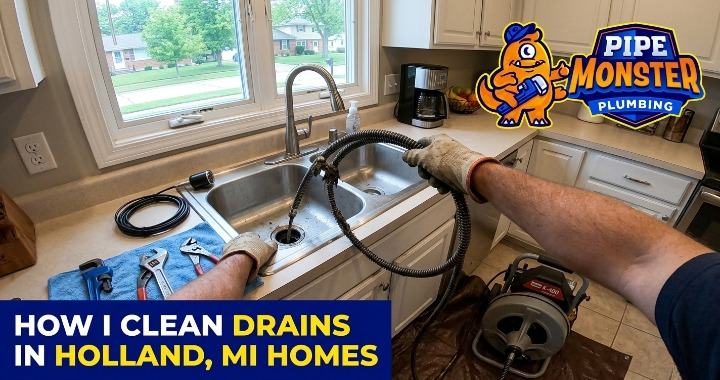
I use a drain snake for most kitchen line work. I don’t go straight to high-pressure jetting on kitchen drains unless the line has hardened grease buildup that a snake can’t break through. Jetting is effective, but it’s not always necessary. And using more force than needed on older pipe systems can cause problems.
After clearing the line, I run water through at full pressure for a few minutes and watch how it drains. It should clear fast and consistently. If there’s any hesitation, I go back in.
I also check the venting. A lot of slow kitchen drains in Holland homes are actually a venting issue, not a blockage. If the drain vent is partially blocked, water moves slowly because air can’t enter the system to replace the water going out. I’ve solved slow-drain issues in kitchens just by clearing a blocked vent stack on the roof. No snaking required.
Bathroom Drain Cleaning Hair, Soap, and Hard Water Together
Bathroom drains are different from kitchen drains. The buildup type is different, and the pipe layout is usually different too.
In most Holland homes, bathroom drains go through a shorter run before connecting to the main stack. That means the problem is usually contained within a shorter section of pipe. But what’s inside that shorter section can be dense.
Hair is the main issue. It wraps around the drain stopper, binds together in the p-trap, and creates a physical net inside the line. Soap scum and shampoo residue stick to that hair mass and build up around it.
In homes with hard water, which is most of Holland, calcium deposits form on top of that. What starts as a soft hair clog becomes a harder, more compact mass over time.
I always start bathroom drains by removing the stopper assembly and cleaning it manually. Most of the time, a significant portion of the restriction is right there. Then I go into the p-trap. Then further into the line if needed.
I use a hand snake for most bathroom drains. It gives me a feel for what’s inside the line. I can tell the difference between a soft hair clog and a hardened buildup by the way the snake moves through the pipe.
After clearing, I test the flow again. And I always check the overflow drain on tubs. That’s a spot people don’t think about. Hair accumulates inside the overflow tube too, and if it’s blocked, it slows the entire tub drain even after the main line is clear.
Main Line Drain Cleaning When the Problem Is Deeper
This is where things get more serious.
When multiple drains in a home are slow at the same time, or when a drain backs up and water comes up somewhere else, like water backing up into the tub when you flush the toilet, that means the main sewer line has a blockage.
I’ve done main line work on a lot of Holland homes, and the issues here tend to fall into a few categories.
Root Intrusion
Holland has a lot of mature trees. Oak, maple, big old evergreens. Tree roots grow toward water sources. Older clay or cast iron main lines develop small cracks and joint separations over time. Roots find those gaps and grow inside the pipe.
A root mass inside a main line doesn’t block everything at once. It starts as small threads that collect debris. Over months, it becomes a significant restriction. I’ve pulled root masses out of main lines in Holland homes that were filling half the pipe diameter.
I use a powered drain auger with a cutting head for root intrusion. It cuts through the roots and clears the line. But I always tell homeowners that root intrusion means there’s a crack or gap in the pipe where the roots entered. Clearing the roots solves the immediate blockage. It doesn’t fix the pipe. If the line keeps having root problems every year or two, the pipe needs to be assessed more seriously.
Grease and Debris Accumulation in the Main Line
In homes with older plumbing, the main line can accumulate grease and debris over years. Especially in the horizontal sections where the line runs below the basement floor before going out to the street.
These sections have a very low slope in some older Holland homes. A low slope means water moves slowly. Slowly moving water drops more debris inside the pipe rather than carrying it out.
For this type of buildup, I use hydro jetting. High-pressure water cleaning that removes buildup from the interior pipe wall, not just punches a hole through the blockage, the way a snake does. It’s more thorough for grease accumulation.
I don’t use hydro jetting on pipes I haven’t assessed first. On older clay or cast iron lines that are already fragile, high-pressure water can cause damage. I check the pipe condition before deciding on a method.
Collapsed or Damaged Sections
Older homes in Holland sometimes have main lines with sections that have shifted, settled, or partially collapsed. This is more common in homes where the ground has shifted over time, or where a section of the line was never properly supported during original installation.
A collapsed section creates a permanent low point where debris collects. No amount of cleaning fixes a collapsed pipe. The section needs to be replaced.
This is why I take drain problems seriously when homeowners tell me they’ve had the drain cleaned multiple times and it keeps coming back. That’s usually not a cleaning issue. That’s a pipe condition issue.
What I Check After Every Drain Cleaning Job
I don’t close a drain job just because water is flowing again.
After clearing a drain, I run a full flow test. I fill the fixture sink, tub, whatever it is to full capacity and let it drain completely while watching the speed. It should drain fast and consistently from start to finish. Not fast at first, and then slow as the water level drops. That uneven pattern means there’s still partial restriction somewhere.
For main line work, I flush the system from multiple points. I run water from the furthest fixture in the house and verify it exits cleanly at the clean-out.
If I used a snake, I would also check whether the line wall feels smooth on the way back out. A snake that catches or drags on the way out of a line means there’s still something attached to the pipe wall that didn’t clear fully.
And I always tell the homeowner what I found inside. Not just that it’s cleared. What caused it, where the buildup was concentrated, and whether there’s anything about the pipe condition they should watch going forward.
Common Mistakes I See Homeowners Make
I’m not saying this to criticize anyone. These are things I’ve seen repeatedly, and I’d rather people know about them.
Using Chemical Drain Cleaners Repeatedly
Chemical drain cleaners can clear a soft clog. They cannot clear a grease buildup that’s been building for two years, or a hair mass with calcium deposits on it, or a root intrusion. People use them, get temporary improvement, and think the problem is solved. The underlying restriction is still there.
Also, and this matters a lot in older Holland homes, chemical drain cleaners are hard on older pipe materials. On galvanized steel or aging PVC, repeated chemical exposure weakens the pipe over time. I’ve seen pipes that were already fragile made worse by years of chemical cleaner use.
Waiting Too Long
A slow drain is not a minor inconvenience. It’s a signal. The line is already partially restricted. If you wait until it stops completely, the buildup has had more time to harden. It’s harder to clear, and there’s more chance of finding pipe damage underneath.
If a drain is noticeably slower than it was six months ago, that’s the time to have it looked at. Not when it stops.
Ignoring Multiple Slow Drains at the Same Time
I get calls where homeowners say the bathroom sink is slow, the tub drains slowly, and the kitchen has been sluggish for weeks. They treat each one as a separate problem.
When multiple drains across different areas of the house are slow at the same time, that almost always points to the main line. Cleaning individual fixtures won’t fix it. The main line needs to be cleared.
How Often Should Drain Cleaning Be Done in Holland Homes
This is a question I get regularly. And the honest answer is it depends on the home.
No fixed schedule works for every house. A home with older galvanized pipes and hard water is going to accumulate buildup faster than a newer home with PEX plumbing and a water softener system.
What I usually tell my clients is this. Pay attention to how your drains behave. If a drain that used to clear instantly is now taking noticeably longer, that’s your signal. Don’t wait for a full blockage.
For homes with older pipe systems, homes surrounded by large trees, and homes without water softeners in Holland, I generally see drain issues develop faster. Those homes benefit from having lines checked more proactively.
For newer construction with modern pipe materials and treated water, you have more time between issues. But you’re not immune. Grease and hair buildup happen regardless of pipe material.
Why I Take Drain Work Seriously
Drain cleaning sounds simple. And a lot of times, the actual clearing part is straightforward. But what’s behind the drain problem the real cause is what matters.
I’ve gone into homes where a drain cleaning revealed a cracked main line. I’ve found pipe sections that were failing. I’ve found vent stacks that were completely blocked with debris, causing drainage issues across the whole house that nobody connected to venting.
If I just clear the blockage and leave without understanding why it happened, I’m not actually solving anything. The homeowner calls again in a few weeks with the same problem.
That’s not how Bryson and I built Pipe Monster Plumbing. We built it around finding the real cause, fixing it properly, and making sure it doesn’t come back. That’s true for drain cleaning the same as it is for any other plumbing work we do.
If you’re in Holland or Cascade and your drains are giving you trouble, slow movement, backups, recurring clogs in the same line, give us a call. I’ll come out, take a look at what’s actually happening, and tell you straight what needs to be done.
FAQs About Drain Cleaning in Holland, MI
How do I know if my drain issue is local or in the main line?
If only one fixture is slow, the problem is usually in that drain line. If multiple drains across different parts of the house are slow at the same time or if flushing the toilet causes water to back up somewhere else, that points to the main sewer line.
Can hard water cause drain problems in Holland homes?
Yes. Hard water leaves calcium and magnesium deposits inside pipes over time. Inside drain lines, these deposits build on the pipe wall and reduce flow capacity. Combined with grease or hair, they create harder blockages that are more difficult to clear than soft clogs alone.
Why does my drain keep clogging in the same spot?
Recurring clogs in the same location usually mean there’s a structural reason that spot accumulates debris: a low point in the line, a joint gap where buildup catches, a change in pipe material, or root intrusion. Clearing the blockage without addressing that underlying condition leads to the same problem returning.
Is hydro jetting necessary or is snaking enough?
It depends on what’s inside the line. A snake breaks through a blockage and restores flow. Hydro jetting cleans the interior pipe wall and removes buildup that a snake leaves behind. For grease-heavy lines or main lines with significant accumulation, jetting is more thorough. For a simple hair clog or soft blockage, snaking is usually sufficient.
What should I do before calling a plumber for a slow drain?
Stop using chemical drain cleaners if you’ve been using them regularly they can damage older pipes. Note which drains are slow and how long it’s been happening. If multiple drains are affected at the same time, that information is important. Don’t try to force anything into the drain line without knowing what’s down there.
Do you check the condition of the pipe during drain cleaning?
Yes. I don’t just clear the blockage and leave. I check what caused it, where the buildup was concentrated, and whether the pipe condition shows any signs of damage or long-term wear. If I see something that needs attention beyond the drain cleaning, I tell the homeowner directly.